I've been thinking a lot about education lately. My wife is getting her teaching certificate, my three sons are going through preschool and elementary school, I'm coaching soccer, I'm learning new skills and I've been working on several computer-based training projects.
I'm just starting to dive deeper into educational theory, so much of what I'll be posting will be from my limited point-of-view. On first glance, there seems to be dozens or hundreds of different educational theories or systems in the literature. A large percentage of these seem to have very little in terms of independent validation.
With regards to teaching a new skill, the following elements seem to be widely accepted:
- Explain
- Demonstrate
- Practice
- Assessment
- Feedback
From my limited reading and experience,
practice is king. From everything I've seen and read, if you want to improve performance, you need practice -- the more the better (almost always). The other four bullets are about setting the student up to practice the right thing in the right way. I'll discuss this more in my next post, but for now I'll lay out a series of references that I've come across recently that show the importance of practice.
Power Law of Learning
I first learned of the
power law of learning when I was taking
Dr. John Anderson's cognitive psychology class at
Carnegie Mellon University. Also called the
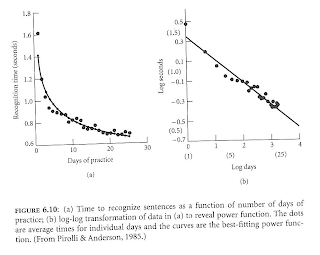
power law of practice, this law states that memory performance improves as a power function of practice and is one of the most validated findings in education. Basically, the more you practice, the better you get and this improvement follows a logrithmic power curve -- faster improvement at the beginning followed by slower improvement as you reach peak performance. This curve is one of the origins of the term, "learning curve." The following graph from Dr. Anderson's
cognitive psychology textbook demonstrates this effect.
The 10,000 Hour Rule
The next reference comes from a very popular recent book called Outliers by Malcom Gladwell. In this book, Gladwell researches and interviews successful people on the extreme outer edge of what is statistically possible and tries to determine how they got there. He finds that in almost all cases it is an accumulation over time of high-quality practice and repetition. Read the wikipedia review of Outliers for a more complete description.
Sports
Not only is this effect true in academics and business skills, but it also applies to sports and physical skills. Gladwell's book documents the case for Canadian youth hockey. Similarly, I remember an article about Russian youth tennis camps based on the same premise (but I can't find it right now). Coaching Youth Soccer by John McCarthy has this nice little nugget, "The more you get your players drilling their skills, within reason, the better your team will be. That's the surest thing about any sport."


